
詳盡技術資料請見原廠或供應商 [ https://docs.beagleboard.org/latest/boards/beagleplay/01-introduction.html ] 料號:102110762
- 本商品為專用於雛形研發實驗之非隨插即用的射頻模組,並非通用終端產品。故須經具備相關知識之專業人士(如:工程師、研究師生、或創客)撰寫程式、燒錄、焊接、外接天線等二次加工,或須與主機板連接使用等方式,始具備訊號傳輸功能,非屬電信管制射頻器材。
- 專業人士在購買前敬請詳閱商品說明與原廠規格書,始可用於您自己的原型設計中自行實驗與實作完整通訊功能。
- 商品本身初始無任何預設應用或功能,故一般消費者上電後無法直接使用,切勿購買。
Description & features
BeaglePlay is an open-source single board computer designed to simplify the process of adding sensors, actuators, indicators, human interfaces, and connectivity to a reliable embedded system. It features a powerful 64-bit, quad-core processor and innovative connectivity options, including WiFi, Gigabit Ethernet, sub-GHz wireless, and single-pair Ethernet with power-over-data-line. With compatibility with 1,000s of off-the-shelf add-ons and a customized Debian Linux image, BeaglePlay makes expansion and customization easy. It also includes ribbon-cable connections for cameras and touch-screen displays, and a socket for a battery-backed real-time-clock, making it ideal for human-machine interface designs. With its competitive price and user-friendly design, BeaglePlay provides a positive development experience for users.
Features
Real world applications for BeaglePlay includes:
- Building/industrial automation gateways
- Digital signage
- Human Machine Interface (HMI)
- BeagleConnect sensor gateways
Supported products
Arm-based processors
AM625 [ https://www.ti.com/product/AM625 ] —Human-machine-interaction SoC with Arm® Cortex®-A53-based edge AI and full-HD dual display
Ethernet PHYs
DP83TD510E [ https://www.ti.com/product/DP83TD510E ] —IEEE 802.3cg 10BASE-T1L Ethernet PHY
Multi-channel ICs (PMICs)
TPS65219 [ https://www.ti.com/product/TPS65219 ] —Integrated power management (PMIC) for ARM Cortex - A53 processors and FPGAs
Multi-protocol products
CC1352P7 [ https://www.ti.com/product/CC1352P7 ] —SimpleLink™ Arm® Cortex®-M4F multiprotocol sub-1 GHz and 2.4-GHz wireless MCU integrated power ampIntroduction¶ [ https://docs.beagleboard.org/latest/boards/beagleplay/01-introduction.html#introduction ]
BeaglePlay is an open-source single board computer designed to simplify the process of adding sensors, actuators, indicators, human interfaces, and connectivity to a reliable embedded system. It features a powerful 64-bit, quad-core processor and innovative connectivity options, including WiFi, Gigabit Ethernet, sub-GHz wireless, and single-pair Ethernet with power-over-data-line. With compatibility with 1,000s of off-the-shelf add-ons and a customized Debian Linux image, BeaglePlay makes expansion and customization easy. It also includes ribbon-cable connections for cameras and touch-screen displays, and a socket for a battery-backed real-time-clock, making it ideal for human-machine interface designs. With its competitive price and user-friendly design, we expect BeaglePlay to provide you with a positive development experience. Some of the real world applications for BeaglePlay include:
Building/industrial automation gateways
Digital signage
Human Machine Interface (HMI)
BeagleConnect sensor gateways
Contributors
This work is licensed under a Creative Commons Attribution-ShareAlike 4.0 International License [ http://creativecommons.org/licenses/by-sa/4.0/ ]
Note
Make sure to read and accept all the terms & condition provided in the Terms & Conditions [ https://docs.beagleboard.org/latest/boards/terms-and-conditions.html#boards-terms-and-conditions ] page.
Use of either the boards or the design materials constitutes agreement to the T&C including any modifications done to the hardware or software solutions provided by beagleboard.org foundation.
 [ https://docs.beagleboard.org/latest/_images/front.webp ] [ https://docs.beagleboard.org/latest/_images/front.webp ] |  [ https://docs.beagleboard.org/latest/_images/back.webp ] [ https://docs.beagleboard.org/latest/_images/back.webp ] |
Detailed overview¶ [ https://docs.beagleboard.org/latest/boards/beagleplay/01-introduction.html#detailed-overview ]
BeaglePlay is built around Texas Instruments AM62x Sitara™ Processors which is a Quad-Core Arm® Cortex®-A53 Human-machine-interaction SoC. It comes with 2GB DDR4 RAM, 16GB eMMC storage, Full size HDMI, USB-A host port, USB-C power & connectivity port, serial debug interface, and much more.
Feature | Description |
|---|---|
Processor | TI AM6254 (multicore A53s with R5, M4s and PRUs) |
PMIC | TPS6521901 |
Memory | 2GB DDR4 |
Storage | 16GB eMMC |
WiFi |
|
BLE/SubG |
|
Ethernet |
|
Single-pair Ethernet |
|
USB type-C |
|
HDMI |
|
Other connectors |
|
AM6254 SoC¶ [ https://docs.beagleboard.org/latest/boards/beagleplay/01-introduction.html#am6254-soc ]
The low-cost Texas Instruments AM625 family of application processors are built for Linux® application development. With scalable Arm® Cortex®-A53 performance and embedded features, such as: dual-display support and 3D graphics acceleration, along with an extensive set of peripherals that make the AM62x device well-suited for a broad range of industrial and automotive applications while offering intelligent features and optimized power architecture as well.
Some of these applications include:
Industrial HMI
EV charging stations
Touchless building access
Driver monitoring systems
AM625 processors are industrial-grade in the 13 x 13 mm package (ALW) and can meet the AEC-Q100 automotive standard in the 17.2 x 17.2 mm package (AMC). Industrial and Automotive functional safety requirements can be addressed using the integrated Cortex-M4F core and dedicated peripherals, which can all be isolated from the rest of the AM62x processor.
Tip
For more details checkout https://www.ti.com/product/AM625 [ https://www.ti.com/product/AM625 ]
The 3-port Gigabit Ethernet switch has one internal port and two external ports with Time-Sensitive Networking (TSN) support. An additional PRU module on the device enables real-time I/O capability for customer’s own use cases. In addition, the extensive set of peripherals included in AM62x enables system-level connectivity, such as: USB, MMC/SD, CSI Camera interface, OSPI, CAN-FD and GPMC for parallel host interface to an external ASIC/FPGA. The AM62x device also employs advanced power management support for portable and power-sensitive applications.
Board components location¶ [ https://docs.beagleboard.org/latest/boards/beagleplay/01-introduction.html#board-components-location ]
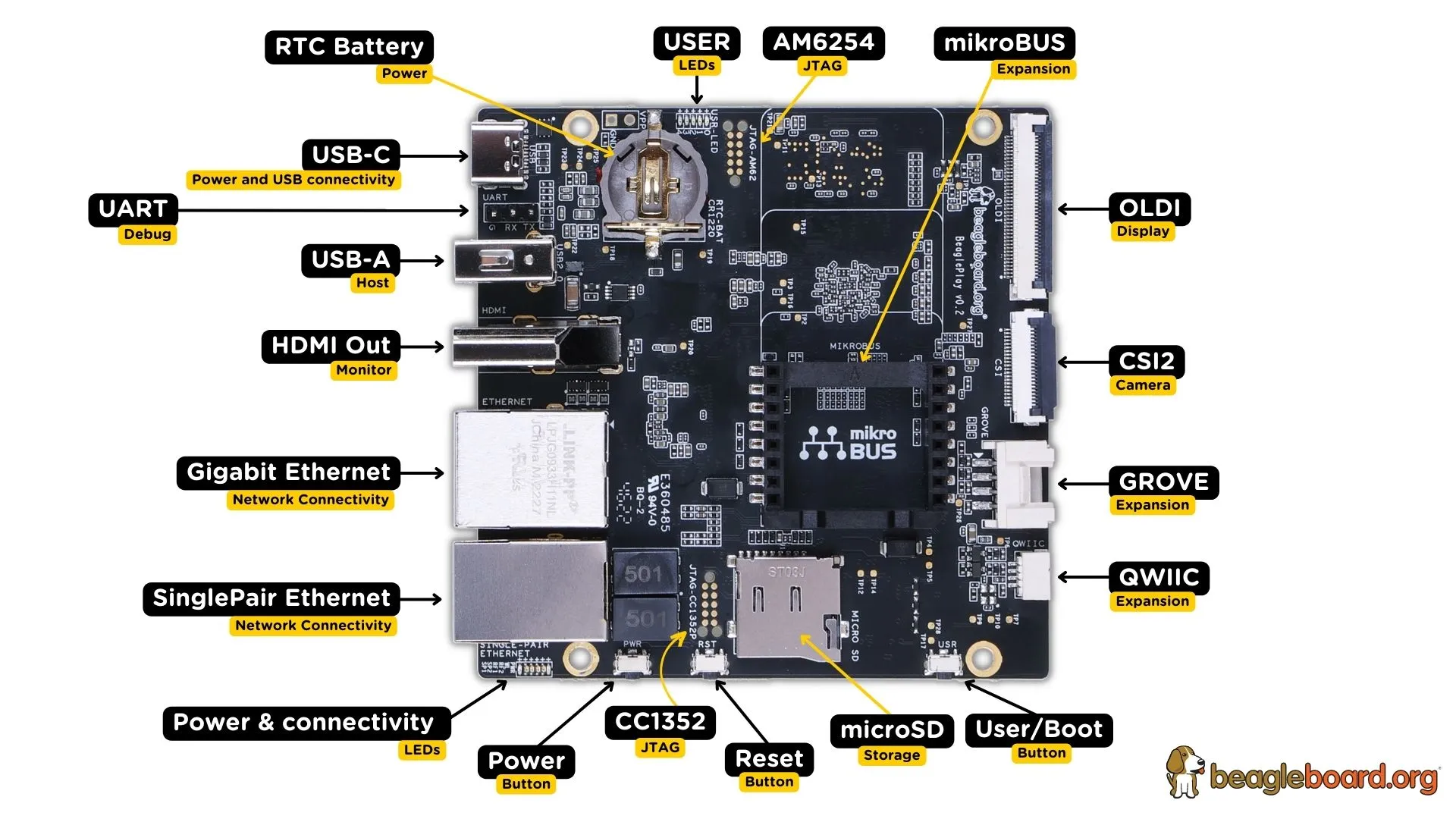
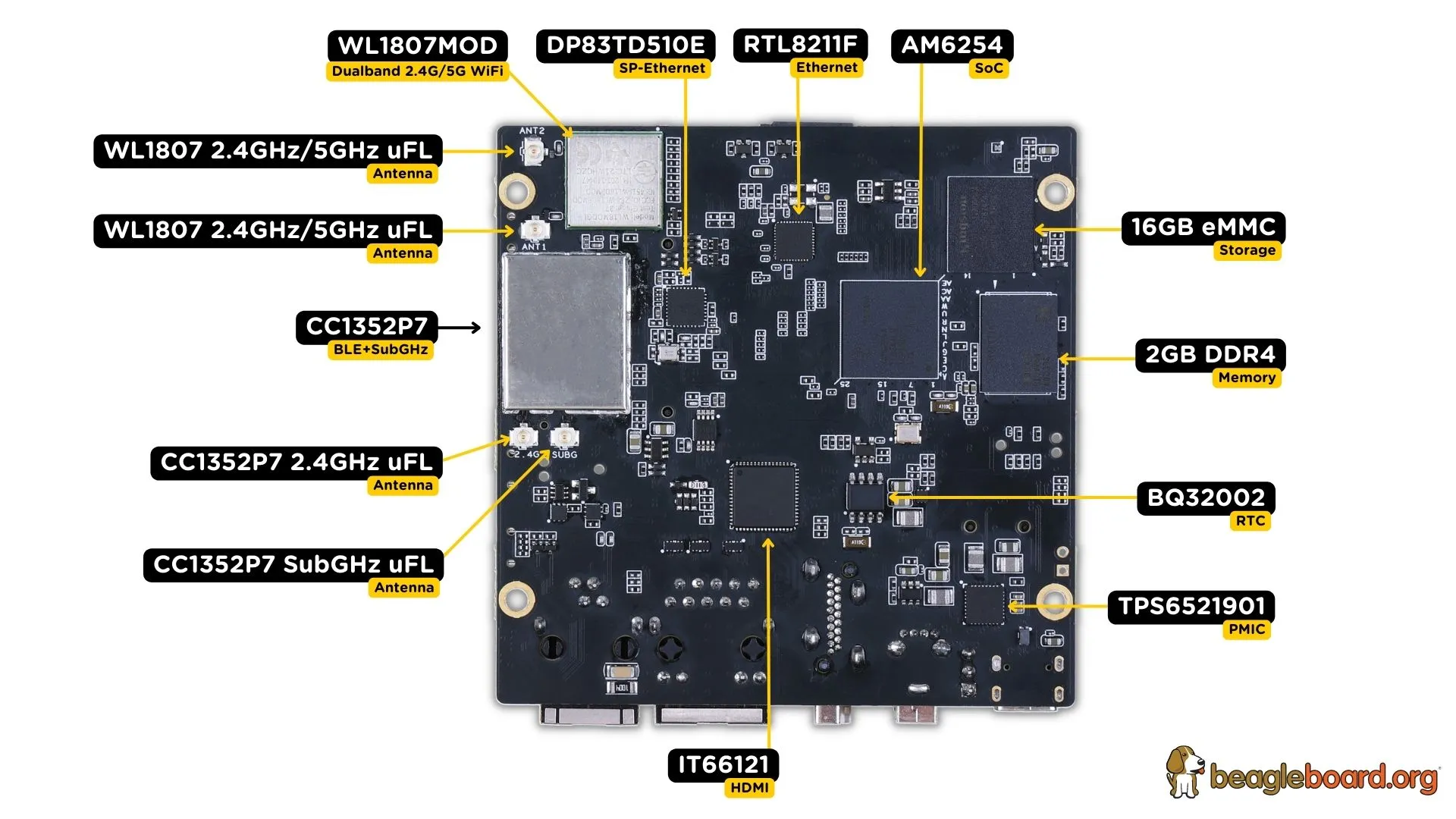
This section describes the key components on the board, their location and function.
Front components location¶ [ https://docs.beagleboard.org/latest/boards/beagleplay/01-introduction.html#front-components-location ]
 [ https://docs.beagleboard.org/latest/_images/components-front.webp ]
Fig. 1 BeaglePlay board front components location¶ [ https://docs.beagleboard.org/latest/boards/beagleplay/01-introduction.html#id2 ]
Feature | Description |
|---|---|
RTC Battery | BQ32002 Real Time Clock (RTC) Battery holder takes CR1220 3V battery |
User LEDs | Five user LEDs, Power and boot [ https://docs.beagleboard.org/latest/intro/support/getting-started.html#board-power-and-boot ] section provides more details. These LEDs are connect to the AM6254 SoC |
JTAG (AM62) | AM6254 SoC JTAG debug port |
mikroBUS | mikroBUS for MikroE Click boards or any compliant add-on |
OLDI | AM6254 OpenLDI(OLDI) display port |
CSI | AM6254 Camera Serial Interface (MIPI CSI-2) |
Grove | SeeedStudio Grove modules connection port |
QWIIC | SparkFun QWIIC / Adafruit STEMMA-QT port for I2C modules connectivity |
User Button | Programmable user button, also servers as boot mode slect button (SD Card/eMMC). Press down to select SD Card as boot medium |
SD Card | Use to expand storage, boot linux image or flash latest image on eMMC |
Reset button | Press to reset BeaglePlay board (AM6254 SoC) |
JTAG (CC1352) | JTAG debug port for CC1352P7 |
Power button | Press to shut-down (OFF), hold down to boot (ON) |
Power & Connectivity LEDs | Indicator LEDs for Power ON, CC1352 RF, and Single-pair connectivity |
Single-pair Ethernet | Single-pair Ethernet connectivity port with power over data line |
GigaBit Ethernet | 1Gb/s Wired internet connectivity |
HDMI Output | Full size HDMI port for connecting to external display monitors |
USB-A host port | Port to connect USB devices like cameras, keyboard & mouse combos, etc |
USB-C port | Power and Device data role port |
Back components location¶ [ https://docs.beagleboard.org/latest/boards/beagleplay/01-introduction.html#back-components-location ]
 [ https://docs.beagleboard.org/latest/_images/components-back.webp ]
Fig. 2 BeaglePlay board back components location¶ [ https://docs.beagleboard.org/latest/boards/beagleplay/01-introduction.html#id4 ]
Feature | Description |
|---|---|
CC1352P7 | 2.4GHz BLE + SubG IEEE 802.15.4 with 1 x 2.4GHz + 1 x SubG uFL antenna |
WL1807MOD | Dual band (2.4GHz & 5GHz) WiFi module with 2 x uFL antennas |
DP83TD510E | Single-pair IEEE 802.3cg 10BASE-T1L Ethernet PHY |
RTL8211F | Gigabit IEEE 802.11 Ethernet PHY |
AM6254 | Main SoC |
16GB eMMC | Flash storage |
2GB DDR4 | RAM / Memory |
BQ32002 | Real Time Clock (RTC) |
TPS6521901 | Power Management IC |
IT66121 | HDMI Transmitter |










此商品暫時沒有評價